


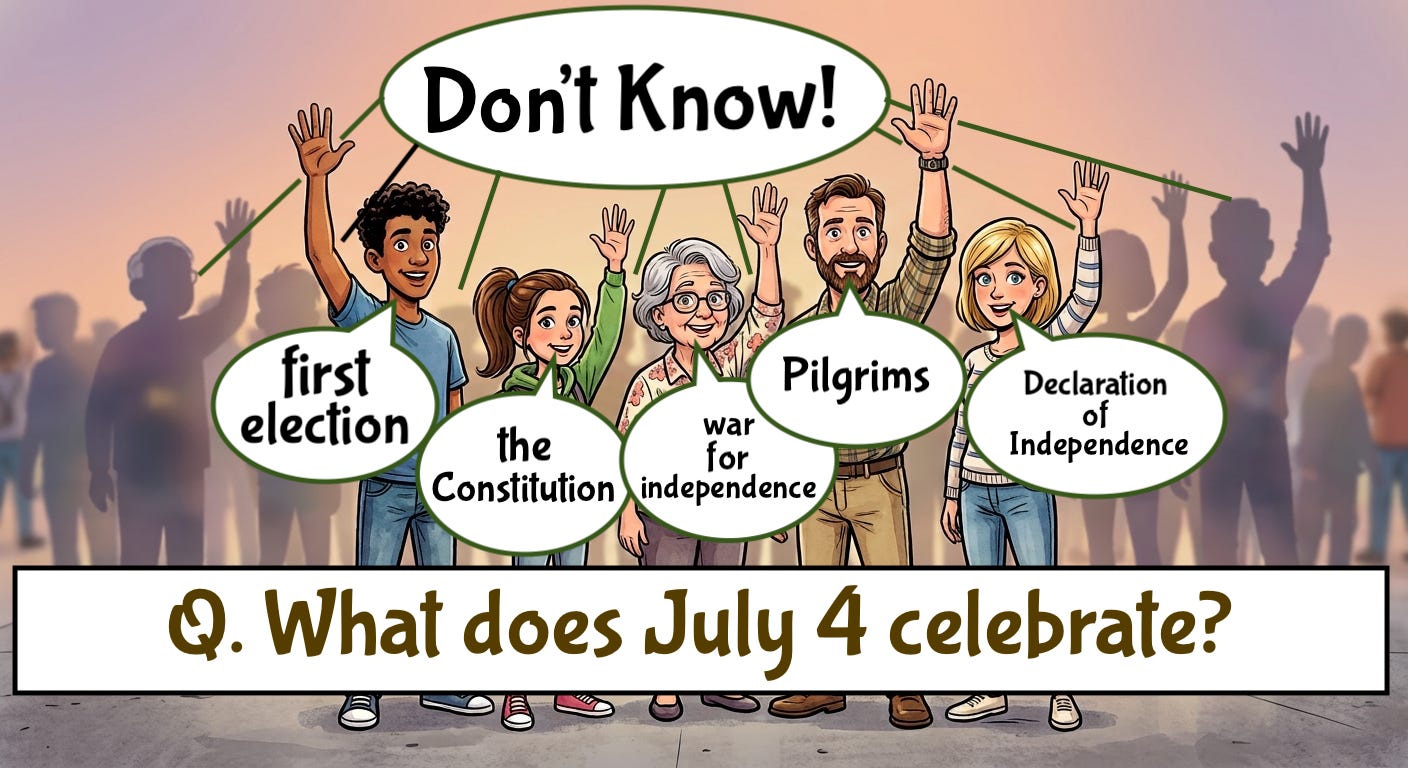
When it gets right down to it, the Fourth of July isn’t any more distinctive than any of the other holidays Americans celebrate. It shares the fireworks tradition with New Year’s Day for example. That being said, the Fourth stands alone in its tiresomely rigid, tri-color scheme. Christmas tree decorators don’t think twice about ditching red and green if it doesn’t fit the living room palette. But if red, white and blue clashes with the patio decor and you’d like something a bit more subdued, go find another country.
The 4th also shares religious holiday status with Christmas and Easter. The difference is that on the 4th, God is forced to share top billing with And Country. Nevermind that fireworks displays never end in lighting up the word GOD in sparkles. It’s always “USA.” Commemorative T-shirts and flag-frosted picnic cakes don’t tout “250 Years of God and Country.” Forgive us for this moment of religious irreverence in the face of facts. But while God is certainly invited by many to the annual, national birthday party, USA is the undisputed guest of honor.
Flashback to 1776: Those 50 guys sweating out Philly’s July heat in heavy brocade vests, frock coats and bulky bow ties weren’t worried about what this nation would actually look like when they signed the Declaration. They were understandably more concerned that they could be marched to the gallows for treason. Even though that didn’t happen, only six of them were alive and firm enough to sign the Constitution ten years later.
This post explores the modern superficiality of the July 4th holiday. In that context, it’s perfectly congruent that the event it honors was a flowery break-up letter with controversial hypocrisies and lack of gender equity. The actual miracles take a back seat—winning the war against all odds (October 1781) and adoption of the Constitution (September 1787).
But July is better for BBQ. Plus, saber rattling has always held cachet over the more mundane, including blood, sacrifice and setting up a novel government. So the Declaration got the federal holiday.
Nevertheless, if there should be a guest of honor in America’s celebration of the Declaration, it is the Constitution.
Those guys in 1787 were worried about a lot more stuff. Clinical cases of anxiety were everywhere. But none was higher than the ability of orthodoxy to cut the life support to critical thinking. In orthodoxies, people give authorities their trust in exchange for a box of “guidance” to solve complicated conundrums they don’t want to bother resolving themselves.
In 1787, the leading source of orthodoxy imported from Mother England was religion. A separation clause was written in to prevent church doctrine from displacing the state. Next, they stuck in free speech protections to shield churches from the reverse. But the assumption was that the population would always share church and state related interests simultaneously. They didn’t see political orthodoxy ever challenging that of religion itself to the degree that it has.
The very word “politics” conjures up fiery rhetoric and faction fighting. But the word “orthodoxy” is a different concept altogether. Adopting orthodox views is like picking clothes off a rack from a stylish shop. That’s much more convenient than personally designing and sewing the clothes. The only thought it requires is to choose the shop (trust) and product (acceptability). But a lot went on behind the scenes to get that clothing on the rack, including the potential that a six-year-old sewed it together in a 90ºF factory. If nobody asks that question, the six-year-old keeps on sweating. Like eradicating child abuse, self-governance depends on questioning the system too.
Down through the centuries, the organized religions that were busted for bad behavior relied heavily on the power of orthodoxy. Church reform movements confronted it to some success. Now, the American Government is benefitting from the same idea far more than churches ever did. Some citizens buy into the orthodoxy that government does too much. Some choose the box marked “government does too little.” Most select neither, preferring not to think about politics at all. They are content to take what they get instead of shape what they get.
Even though the Constitution writers disagreed sharply on the level of federal government power, they mostly agreed that government should be a system that works unobtrusively in the background. But liberty didn’t mean average citizens are free of the responsibility to participate in government. At the bare minimum, it is a citizen’s civic duty to at least pay attention. And, if in doubt, ask pesky questions.
This brings us back to evaluating the Fourth.
National holidays were all set aside to commemorate something a lot more profound than BBQ skills. Yet who, while watching a parade or a fireworks show this weekend thought, “Man, we sure have come a long way but we still have a lot of work to do.” Too many symbols and too much ritual make people think flag waving equals commitment.
My country right or wrong, is an extreme nationalist slogan. Most are more subtle, but they are summarized by the word “superiority.” It is hard to eradicate nationalism once it takes root. It conflates a share of achievement with mere association—a lot like the relationship of a fan with a sports team. But the sum of an individual life is not represented by the accumulation of birthday candles. It’s the 364 days in between that count.
This circles back to churches and states, which is really how this whole America thing began (Pilgrims, remember?). The epic battle between humility and ego is central to all the world’s religions and philosophies. So what’s up with all the America Kicks Butt superiority jingo-messaging each July 4th? (it didn’t start with Trump) Answer: ego triumphing over humility again.
Americans are indeed the custodians of a system that strives toward self-governance. It demands citizen vigilance to keep it on track and keep it evolving. Constant preoccupation with the shallow siren of superiority achieves nothing. Orthodoxy is the ultimate enemy to freedom because it proxies commitment. It leaves power unattended. History proves that power left to its own whims becomes arbitrary, which threatens to walk America right back to where it started 250 years ago.
Just. Sayin’.
Scroll down for the Afterthoughts after the following commercial breaks, where we look at some of the actual results of the poll that inspired this post.
Would you like to a)tell us how wonderful we are b)tell us to crawl back where we came from c)tell us about your Fourth of July BBQ? (no pictures please, we do enough grilling around here in the interrogatory sense). Write us a private email! Send your bribe observations to: tomigrote@substack.com. We promise we won't out your trash talk to your church congregation.
Know somebody who would be interested in this Substack? If you got this as an email, forward it. Tell the recipient to look for links within the post to subscribe for free. Or say something about it on social media and include the web address tomigrote.substack.com. Thanks so much for helping spread the word about this completely volunteer effort.
Afterthoughts, Observations and Authentications
🟧 The inspiration for this post was the recent release of poll results that found almost 50% of the sample couldn’t pick the event the 4th celebrates out of a lineup of options. It isn’t noteworthy to us if a substantial segment has all the pages of the nation’s founding stuck together. But 16% chose honestly “I don’t know.” Of the wildly off, the leading answer was the first presidential election followed by the Pilgrims landing. They accounted for 15% of the sample. This set off a lot of reasonable handwringing about civics education (a majority of Gen Z respondents could not correctly identify Great Britain as the country the colonies broke away from).
🟧 We would trade event illiteracy for a basic knowledge of what the Constitution and the Bill of Rights say any day. Predictably, the poll result on that subject was worse: 21% chose “I don’t know,” even from a list of hints. A majority guessed and got it wrong. However, close to 80% expressed affection for and pride in the country. That’s what set off our angst about superficiality. It was echoed by the pollsters’ own observations: while the emotional connection to America is rock-solid, the lack of historical and constitutional literacy makes it harder for the public to recognize or defend against modern overreaches of government power. Our posts frequently take that fear down to the local level, where the consequences we report are very much in evidence.
🟧 Although the poll found strong emotional attachment to the country, it did spot great anxiety about the future. This is consistent with several other polls we have seen. But how can self-government hope to face the future if illiteracy and indifference about its foundations and provisions is so prevalent? When a citizenry surrenders the chore of attentive self-governance to the orthodoxies of those who hold office or have a special interest, where does that go over time? America only has enough history to have the barest clue. We know from experience what happens when individuals who are not versed in civics go up against The Establishment. It’s usually not pretty. But citizens who know their stuff (or who can afford a lawyer who does) fare reasonably well. Is that what is called self-governance? Just asking.
🟧 The American electoral system strives to be an orderly mechanism to establish the leadership hierarchy essential to human social order. Especially in local government, the quality of leadership is heavily influenced by the standards set by the followers. Take Martin Luther King as an example. He was unquestionably the leader of a large and sometimes contentious movement. But the movement’s success was the ability of the followers to inspect, embrace and express a complex message. King was not wholly responsible for the quality and power of that message. The movement membership’s commitment to and literacy about what they wanted to accomplish was the secret sauce.
If the concentration of power in the hands of a few people is to be blamed on "modern capitalist culture," then please explain oligarchs and party hierarchy in collectivist cultures. My love of horses has taught me a lot about human social order. The human version of herd mentality is a lot more elaborate (we always have to make things soooooo complicated) but it's the same mechanism. Once the pecking order is established, members of the herd cease to question it. When there's a leadership contest, the shuffle only involves the top, the rest of the herd goes on grazing and looks up only to see who won.
So it is with human social order. Over the years, I have changed my mind a lot about voting. The very nature of liberty makes it an option. It is an ethic that nobody has the authority to impose on any other American. I wish more of my fellow citizens would place the same priority on civic participation/interest that I do. But that is just not the way humans roll, nor has it ever been any different, regardless of economic system or political philosophy.
The post concerns those who do vote. Orthodoxies relieve those who subscribe to them from the nuisance of paying attention. As we said, self governance demands citizen vigilance to keep it on track and keep it evolving. Delegating the formation of individual informed opinion to orthodoxy shrinks that restorative supply of independent thinking power. But the poll results point to an even greater consequence. How will Americans know when their rights are threatened when they don't know what they are or why they are?
Once again, you hit all the buttons. I am not surprised by the poll numbers you mentioned. But I was recently shocked to learn that 90 million people did not vote in the 2024 election.
In 1985, historian Donald Worster wrote, "The controlling American definition of justice, as many have observed, has been one of open opportunities and plenty of them. Restrict those opportunities to a privileged handful, smaller and smaller in number, and, in many people's eyes, the state and its efforts begin to appear less legitimate, less supportive. Everywhere modern capitalist culture faces such a contradiction, and faces, if it cannot resolve the tension, its own death."
We the People are the three iconic opening words of the Preamble to the U.S. Constitution, which establishes that the power of the U.S. government originates from its citizens. To stop the rising authoritarianism of the privileged handful and to resolve the present tension Worster alludes to, we, the people, need to resist the rise and show up and vote in November.