
Little-Big Stuff
It's Spring Cleaning Week at Letters. Here's a bouquet of wild flowers we've been collecting for comment that need a "Just. Sayin'".


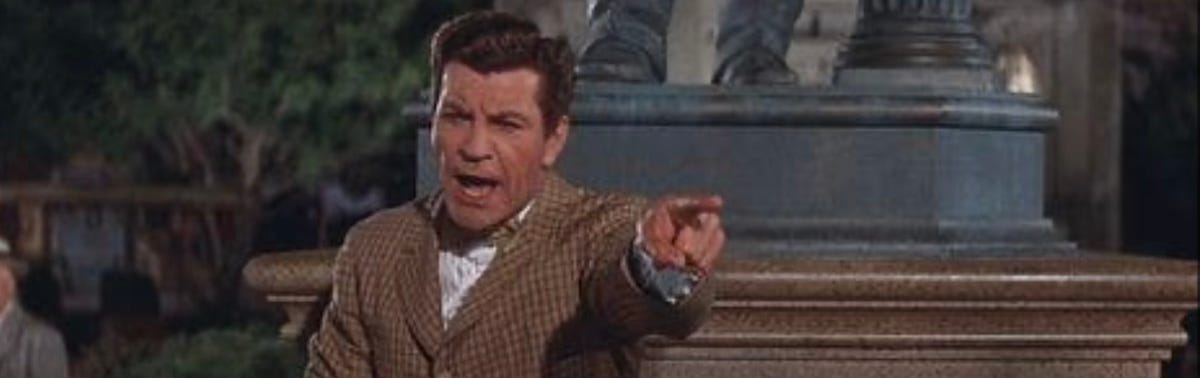
Robert Preston telling the town of River City, Iowa that “they’ve got terrible, terrible trouble.” Just like the Donnelly Public Library is telling its public. (Scene from the 1960’s movie “The Music Man”)
This post is a bit different than usual and requires a table contents:
Wildflower #1: Donnelly Librarian’s “Adult’s Only” Rant Hits the Big Time
Wildflower #2: Cascade Medical Center’s Patience Turns Into Impudence
Wildflower #3 Hail to Their Majesties, the Imperial Idaho Department of Transportation
Wildflower #4: Afterthoughts: McCall Memorial Hospital District March meeting
Wildflower #5 Nerdist Colony: First Amendment
Wildflower #1: Donnelly Librarian’s “Adult’s Only” Rant Hits the Big Time
In early March, The Star-News covered a contentious public forum concerning the Donnelly Library that drew 40 people. It’s rare to get that number to show up at a McCall event, so this had to be the pinnacle of the social season for Donnelly.
The forum was for the board to admit to the library’s patrons, a tad belatedly (over a year had passed), that somebody had authorized joining a national lawsuit. The little library is the adorable, poster toddler among giant publishing houses suing the state attorney general. The fight is over an Idaho law that requires books deemed to be “harmful” to minors to be re-located away from the children’s section. The Donnelly library doesn’t have enough square footage to do this, complained the librarian. Near the time it was filed, The Star-News duly reported the library’s participation in the lawsuit, but quoted the librarian exclusively and didn’t cite official board authorization.
Despite the newspaper account, local supporters of the state law caught wind of the library’s unilateral advocacy only after it had already lapped an anniversary. And if not for them, one of Valley County’s tiniest taxing districts would have gotten away with one of the most consequential corruptions of process and open meeting law violations we have seen. Flaunting the Idaho Open Meeting Law is not the cosmetic knit-pick public servants so prevalently think it is. It is an affront to public trust, as this action most certainly is—regardless of what anybody thinks about the library law itself.
The stand-out feature of the Donnelly Library public malpractice is that it goes beyond open meetings. There’s nothing on the public record that confirms just who made this lawsuit authorization. If the board chair signed a pleading (which is necessary to join a lawsuit) without an official board vote, she is at risk of what is commonly called a “misuse of public standing.” So it’s really up to the citizen opposition group how far they want to take this. A visit with the county prosecutor would be a prudent next step.
This tale affirms a recurring theme of ours. Board trustees become so deferential to their staff, they lose the point of their service. Their public purpose is to contribute independent, analytical rigor to the institution on behalf of the taxpaying public. But that’s not what happens. The narrow groupthink of a few subsumes their perception of wider public interest. While serving on a board is unquestionably a laudable act of community service, too often it isn’t selfless. Too often, it resembles joining a service club or a church to further a defined “mission,” as we explored at length in a post last year (see Links section). If the function of boards is to independently oversee public employees and processes, and all the board does is rubber stamp whatever the staff recommends, is that a public good?
The Donnelly Library Lawsuit as Civic Allegory
This all started back in 2024, when the library director waaaaay overstated the impact of the law by unilaterally and provocatively announcing to the press that the library must turn into an “adults-only” facility. She also single-handedly (and inaccurately) declared what the library’s legal vulnerability would be, without any evidence of having consulted legal counsel—or her board.
A librarian does not have the authority to set policy without board approval. This particular librarian was on a rant and was not to be stopped...until the facts caught up with her.
When the facts did, it led to a most awkward “nevermind,” by her and her board. They created a fairly simple system to accommodate children that was in compliance with the law and not disruptive to library operations. Even the library’s insurance company Winnie pooh-poohed (sorry :) the librarian’s hand-wringing about liability risk.
Lots of observers are waiting, including the legislature, for where the courts are going to take this book segregation argument. The Donnelly Library lawsuit is currently treading water, while a related lawsuit winds through the courts. Our bet is that the state law will, rightly, be found unconstitutional on First Amendment grounds (join us in Nerdist Colony for why). But even if the Donnelly Library side ultimately wins, its public still loses—unless the patrons hold the board to account for such irreverent public process chicanery.
We applaud the stated motivation of the group who stepped forward to contest this behavior. “This is not a debate about books or politics,” a member said. “It is about transparency, accountability, and public trust.” The fact that somebody other than us “gets it” that perfectly, is enough to make a pair of old, hidebound public process advocates cry. Rock On, guys! Just make sure you don’t veer off into “books and politics.” We’re watching.
Wildflower #2: Cascade Medical Center’s Patience Turns Into Impudence
Just before Christmas, we wrote about Patience, our nickname for the chair of the Cascade Medical Center Board of Trustees. She gave us an early Christmas present by calmly persuading her fidgety colleagues that allowing the public to attend meetings of the board’s advisory committees was not the equivalent of Santa peeking into their bedroom windows.
“We are a public entity, and the community has the right to see how we do things,” Patience said. We thanked her and happily settled into a long winter’s nap only to be rudely awakened at CMC’s March board meeting.
Emboldened by the board’s December action, we asked the board to go one step further and post the board packets on the hospital’s website. These are documents and reports regarding upcoming agenda items given to board members in advance.
We were chagrined when Patience turned into her alter ego, Impudence. “There are sensitive things in the board packet that I don’t think we should burden (the administrator) with the chore of redacting,” she said. Geez, Louise. In three months, “the community has the right to see how we do things” had changed to “of course, we don’t want them to see too much.”
What Impudence obviously did not realize was that meeting packets are routinely provided to the public in advance by governing boards elsewhere so that the public can refer to them for details. Most notable among these agencies is CMC’s cousin up the road, the McCall Memorial Hospital District, which posts packets of the board and advisory committees in advance. Without seeing the information the board sees, the observer must accept the board’s interpretation of it. That...is...not...GOOD ENOUGH!
More importantly, online packets serve as the historical record to supplement often sketchy meeting minutes for those wishing to answer the question, “what exactly happened there?” In addition to all of the above, add the simple fact that packets become public records from the moment they are distributed to board members and can be requested by any citizen at any time. So why make them do it? Remember another of our recurring taunts: the Unless You Ask, It’s None of Your Damed Business philosophy of public disclosure?
The misguided remarks by Impudence gave the green light for other board members to chime in with equally irrelevant observations. Their comments and our replies are below.
First, our reply to Impudence: The only documents that qualify as too “sensitive” for public disclosure would be evaluations or complaints about employees or someone threatening to sue the hospital. Those topics should be discussed in closed session as allowed by law and should not appear in the board packet to begin with.
Comment by Board Member No. 1: “Board tactics, including minutes, need to be reviewed by the board and corrected accordingly before they go out for public consumption.” Our reply: Draft minutes are clearly labeled “draft,” and there are rarely any changes, so there is no danger of people repeating some horrible lie.
Comment by Board Members No. 2 and 3: “We discuss everything in the board packet in the board meeting, so there shouldn’t be any surprises. I think with it being open meetings, there’s ample opportunity for people to attend.” And: “That’s why we’re doing the open meeting so that they’re available for the people. I don’t see that we have to take another step further.” Our reply: Sure, people can show up and listen to the meeting, but they have no freaking idea what is going on if you guys are looking at documents not available to them. Besides that, the main value of posting the packets is to serve as an archive to supplement the agendas and to corroborate what is recorded in the minutes.
This discussion can be summed up in one simple fact: Meeting packets do not belong to the board; they belong to the public, and to withhold information about the operation of a public hospital is a violation of the board’s public charge and trust.
We miss you, Patience! Please come back!
Wildflower #3 Hail to Their Majesties, the Imperial Idaho Department of Transportation
Recently, local online news site Valley Lookout reported what it called a “deep dive.” Whenever any outlet uses that term, it always makes us wince because they never are. The Idaho Transportation Department (ITD) continues to study a bypass of the Rainbow Bridge bottleneck on state Hwy. 55. Valley Lookout’s softball interview with an agency official was a stunning failure in the watchdog role of journalism. Everybody recalls the eye-watering construction FUBAR on this arterial north-south roadway early this decade. In fact, Valley Lookout’s parent, BoiseDev, did the only admirable in-depth questioning of what exactly happened when a projected $19M budget ended up a $62M outrage.
Even Governor Brad Little ordered a “full report” from ITD. The response he got was a whitewash that resembled a lamppost reporting how it feels about dogs. So, congratulations to The Imperial Department of Idaho Transportation. If you can thumb your nose at the governor and the press, you may now hold yourself officially unaccountable for anything you do. For citizens to still have no explanation for the highway robbery of the early 2020’s is egregious.
Such snubs should cost ITD any credibility with the press or the governor’s office. If they won’t demand satisfaction for citizens, we call on the legislature to extract for taxpayers a detailed examination. The governor stood down and the public’s watchdog rolled over for ITD to scratch its belly. Under these circumstances, anybody expecting the worst in ITD’s next Hwy. 55 boondoggle will not be disappointed.
Scroll down for the Afterthoughts and Nerdist Colony after these Links:
• The Give Us A Vote! citizens coalition wrote a viewpoint published in The Star-News Thursday, April 9. It complains about how hard it is to teach an old dog like the McCall Memorial Hospital District board new tricks. The Star-News is paywalled, so we re-published the piece on GUV!’s home page.
• Remember Hal from 2001, A Space Odyssey? He wasn’t disconnected. He sits on a lot of local boards.
🟧 Wildflower #4: Afterthoughts
There’s a link above to a viewpoint the Give Us A Vote! citizens coalition recently wrote for The Star-News. In it, we likened the future projects the McCall Memorial Hospital Taxing District was considering with what the Idaho attorney general was investigating. The point was that the board has learned very little from being under the microscope of the state’s top cop. A couple points we wanted to make had to be cut to make the newspaper’s word-count limit. They are:
• The news media reported two (completely unnecessary) replacement projects St. Luke’s had proposed to them in the meeting, but left out a glaring one. The idea was floated by St. Luke’s to levy money just to park it for a rainy day. That’s like a school board proposing a supplemental levy “in case something comes up...we’ll know it when we see it.” To the board’s credit, they left that suggestion on the table. But the fact that an SLM official felt comfortable suggesting it and no one spoke against its impropriety, is an indicator that nobody grasped the implications.
• One little kernel that came out in the board meeting particularly amused us at GUV! When we filed our complaint with the AG, there was a spirited outcry from board members that we irreverently discounted the “necessity” of the public paying for an urgent care center for a highly profitable corporate medical conglomerate. They said the urgent care center would not now exist because St. Luke’s said there wasn’t enough market in McCall to justify them spending money on one themselves. Turns out, only a few years later, the UCC is busting at the seams. Quote from the 3/17 meeting: “(Urgent Care Clinic), they’re up to seeing at least 30 to 35 patients a day on our non-seasonal busy times, and can see up to 45 to 50 during the summer. So they are quickly needing or outgrowing the four exam rooms that they have available to them...” Providing more taxpayer funded exam rooms is a good use of more public funds, the hospital official suggested. So, either St. Luke’s can’t read a market or, more likely, they are experts at knowing how a little stonewalling can go a long way when a board shows interest in something they had in the plan all along. In fact, the same hospital official admitted as much shortly after the clinic opened. She said the taxpayer funded UCC opened “a few years” earlier than it would have if Luke’s had funded it on their own. Was the $2.66M the district’s taxpayers paid to get a “few years” jump on a service SLM would have installed on their own worth it? Especially in light of how they now admit it took off? Discuss.
🟧 Wildflower #5: Nerdist Colony on the First Amendment
• Free speech defenders like us are eagerly watching the First Amendment aspects of the two lawsuits related to the Donnelly Library participation. The Donnelly librarian cited the physical inconvenience of complying with the law, which in almost all cases were of her own making. When she and cooler heads put their minds to it, unobtrusive means to compensate were found. That’s not the way to look at this.
• At the real heart of these cases is the state law’s barn-door-broad definition of “harmful.” What one parent finds harmful, another parent finds educational. In the 1960’s this type of struggle was hilariously spoofed in the musical The Music Man. This is way over-simplifying to make a point: the First Amendment presumption is that government cannot impede access to ideas, especially when the barrier is viewpoint driven (i.e. in the eye of the beholder). That same right extends to children, albeit in a more limited way than adults. The principle is the same. Moving a book out of the children’s section based on subjective criteria, places a tangible “barrier to discovery” in front of that child. It does the same for the child’s parent. They obviously can’t keep a database of children’s books in their heads, so they have to find a workaround to the barrier. That constitutes a legal impediment.
• The legal definition of sexually explicit material is the only classification that lawfully justifies restriction to minors. And that definition is extremely specific. That’s where laws like the one the Donnelly library is fighting run into trouble. The Idaho law allows a citizen to complain about any library offering, then the board must deliberate. All of this reeks with the legal definition of subjective judgment. Subjectivity is a super un-First Amendment concept. The current Supreme Court has been extremely hostile to such arguments in First Amendment cases, as we suspect they would be here if the case gets that far. The First Amendment does not recognize even a “community standard” unless in the context of pornography. So it’s highly likely that this problem will resolve itself in time. Weirder things have happened, so we still keep our fingers crossed. America’s First Amendment is the most anti-government intervention ethic in the world. The legal question in these cases is not whether restrictions for minors can exist, but whether the standards and who gets to decide are precise enough.
• The Donnelly story gets nothing right, as we pointed out in the post. But the other aspect to which we draw our readers’ attention is to legislative grandstanding. It’s one thing to test court appetite for reforms from time to time by passing laws that poke at a little aspect of something to see if there’s any give. But if we are right, this Idaho library law will have rebuild itself into toothlessness after years of litigation at taxpayers expense. Not only that, but the legislature (who touts its “fiscal responsibility”) will also have put Idaho libraries through a lot of unnecessary compliance crap, just so they can puff their chests out to their base. We wish there was a way to discourage that, but they think it works for them so they keep doing it. Only citizens can tell them otherwise.
• Have a First Amendment question? We’re not legal experts, but we never tire of talking about the nation’s most distinguishing and controversial constitutional promise. Email us at tomigrote.substack.com
Thanks!...lots of great information and fresh viewpoints that "somehow" just never make it into the "news".
Looking forward to the the next bouquet!
A board should be accountable, transparent, and act in the public trust. I proudly served on the McCall Library Board of Trustees, not because I had an agenda. I served to give back the gifts I have received from librarians and libraries my whole life. The board I served on never rubber-stamped anything. In fact, when we didn't have the information or data to make a decision, we would table an action item until we did. We asked the city council and city attorney questions and worked for a year on a new library policy that protects all patrons.
I think you give the group that stepped forward too much credit, because the underlying members of some of the most vocal in this group posted nefarious attacks that began with a state representative (who removed her post after the backlash) and unfounded comments by three other members of the group about the library director displaying pornographic books. My experience with the members of this group is that they are the few who are anti-library, narrow-minded, hateful people with a personal agenda, who want to impose their beliefs on others, take over the board, and remove the library director. So, while I agree with raising the issue about the Donnelly board, there may be more to the story about who knew what, when, and why the public didn't say anything for a year. Board meetings are open to the public. I believe the Donnelly board will make a statement soon.
I don't applaud the ill-mannered behavior this group has displayed in their social media posts, which made it clear it was all about books and politics for them.
I agree with your comments on #5 and hope the courts will overturn the state law.
I will always support the basic aim of any library: a place that provides free, equitable access to information, and I will challenge those who would try to take that right away from the public. As always, thanks for your comments.