Author’s Note: this is the final post in our three-part series on the local primary election May 19.
Ah, when the world seems turned upside down and our nation is being run by a succession of presidents from the House of Slytherin, there is one unshakable force of nature everybody has a chance to understand: local elections.
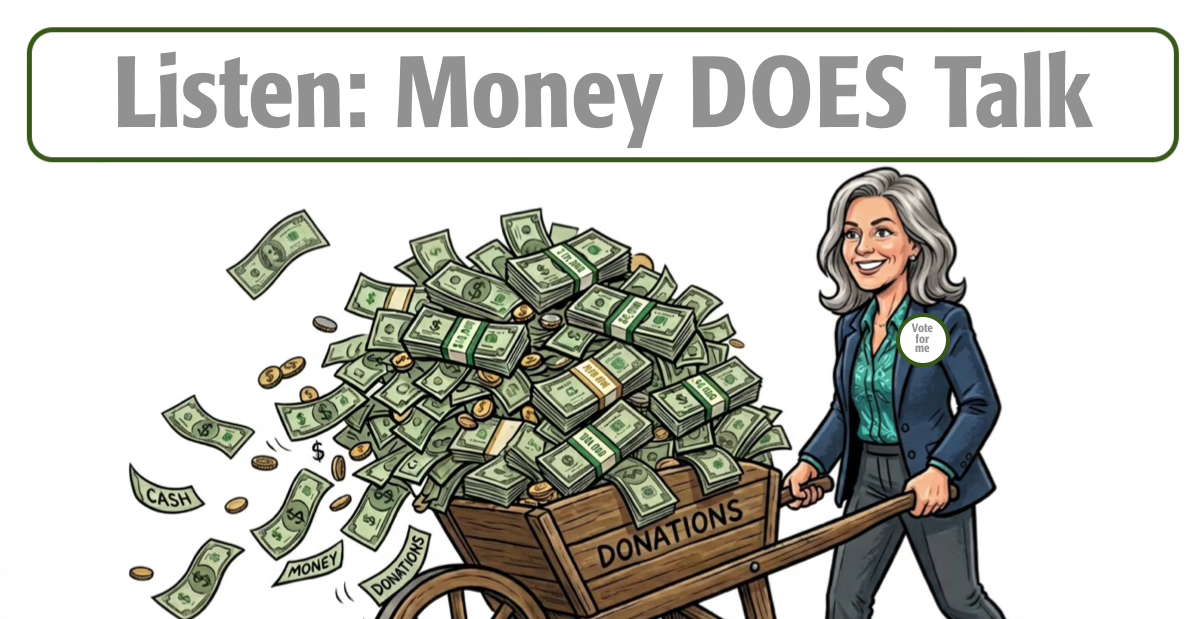
But to really get a clear picture of a legislative candidate, we recommend the tried-and-true advice Deep Throat gave to journalist Bob Woodward of Watergate fame: “follow the money.” In our experience, what comes out of any candidate’s mouth so closely echos the special interest money supporting them, you can set your watch by it.
‘Letters’ is free (and worth every penny)!
Legislative District 8 Overview
Valley County is in legislative District 8, out of which comes a three-way senate race for the Republican nomination that is commanding the undivided attention of political watchers all over the state. To say that all three candidates, incumbent Christy Zito and challengers Megan Blanksma and Terry Gestrin have previous legislative experience is a gross understatement. Combined, they have served 13 terms. Blanksma was for a time, the second highest ranking Republican party member in the Idaho House (House Majority Leader) before a photo-finish defeat to Faye Thompson in 2024. Zito has never lost in four races and has unseated two incumbents along the way. That’s an astounding statistic because in the 2024 primary, PACs spent $45,500 to defeat her against $11,000 on her behalf. In that race, she still beat an incumbent by 12 percentage points, heart-stopping under the circumstances.
Below, we follow the money for each candidate. The only vocabulary lesson needed is a category called “Independent Expenditures.” Political Action Committees (PACs) can contribute directly to a candidate but are limited to $1,000 for primary and $1,000 for general. However, because campaign messaging is protected by the First Amendment, there is no limit for “Independent Expenditures.” That’s where the real money shows up. Under this category, there can’t be any direct coordination with the candidate. So, if a mailer shouts, “Candidate X Voted For Bad Thing Y,” that’s an Independent Expenditure. IEs have to be reported, but they are not capped.
Author’s Note: the descriptions of candidate political positions is deliberately general because we covered that at length in a previous post (see Links section).
🟧 District 8 Senate Candidates (all figures taken 5/7/2026, final figures will vary)
Christy Zito (incumbent)Total: $41,500. Total Fundraising: $26,500 Independent: $15,000
Her Politics: Zito belongs to what we call the Guns & Jesus, arch conservative faction. They are predominantly Religious Right Christians and fiercely protective of the 2nd Amendment right of self armament. They are committed to “holding the line” on government spending, although they have no problem with government spending on stuff they favor (like tax credits for home schooling). They resent regulations, but are all for heavily regulating anything connected with LGBTQ rights and immigration.
The Money: Things have quieted a whole bunch since a 2024 spending free-for-all that put Zito’s first bid for a senate seat in headlines statewide. So far, she has collected about $5,300 from individuals residing inside District 8 versus $11,800 outside it. Zito has one $1,000 contributor from McCall but no one who is a noteworthy local business or public figure. In-District company contributions show an even greater share coming from outside District 8 as opposed to inside it ($750/$3,500). Among the company contributions, there don’t appear to be any dominant influences.
PAC/IE Money (direct contributions + independent expenditures): Zito’s PAC contributions total $4,750. All but one contribution comes from the Valley and Boise County Republican Central Committees ($2,000 each). The other is a hard-right source based in Coeur d’Alene. Independent Expenditures: $15,000. Zito’s outside support comes from two hard-right PACs active in other races: Make Liberty Win (school choice advocate) and Citizen’s Alliance, an Idaho chapter of a hard-right national PAC. No independent expenditure opposing her was listed.
Megan Blanksma Total: $56,850 • Fundraising: $23,100 • Independent: $33,750 (almost all in opposition)
Her Politics: Blanksma belongs to Those Were The Days, our establishment, classic Reaganite faction. They believe that what’s good for business—especially Idaho’s pillar ag, timber and mining interests—is good for everybody. That same institutional devotion extends to public schools, public unions, etc.
The Money: In 2026, Blanksma is where Zito was in 2024. She’s drawing some eye-popping opposition spending from a national school choice advocacy PAC. Unlike Zito in 2024, that spending (so far) is not being countered by support groups. Individual donations in district: $4500 / out district: $6,600. Noteworthy local contributors: Ken Roberts (chair, Valley County P&Z), Scott Turlington (CEO, Tamarack Resort). Her company contributions are $2,000 from two businesses, one of which is May Hardware in McCall ($1,000)
PAC/IE Money: Blanksma has 10 PAC contributors at $1,000 each ($10,000 total). They are unions (3), hospital interests (2), agriculture/resources (4) and pro-life (1). This is a great example of how this list lines up with our description of her politics.
Terry Gestrin Total $2,700
His Politics: Like Blanksma (above) Gestrin leans strongly with the Those Were The Days faction. He is not an outspoken ideologue like his opponents, but deeply identifies with agrarian roots—which is logical since he owns/operates Long Valley Farm Service in Donnelly. He says controlling invasive species is his predominant interest.
The Money: Gestrin is noteworthy in that all of his funding sources come from within Valley County. That contrasts his opponents, who both post lopsided figures from out of area individuals and interests. Former Valley County Commissioner Bill Willey ($500) and Tamarack Food and Beverage ($1,000) are his noteworthy contributors. He has no PAC or IE contributions listed.
Know someone interested in local politics from a voice of experience?
Note: We are not covering the 8A House race between Rob Beiswenger and Sean Hall because the candidates’ political leanings are similar and the race has no local candidate. To date, incumbent Beiswenger has raised $38,360 to Hall’s $2,000. Their political views have recently appeared in Valley Lookout and The Star-News.
🟧 House Representative, District 8B
Brian Beckley Total: $100,600. Fundraising: $55,600 Independent: $45,000
His politics: Beckley appears to be the darling of the Those Were The Days establishment faction. He has over twice the war chest of any other District 8 candidate—even the hot Senate race. He resigned as chair of the state parks and recreation board to run for the legislature. So he is known in Statehouse circles and is likely being eyed by his faction as having leadership potential. His financial support is heavily skewed to business interests as is typical of those with similar politics.
The Money: Beckley’s in-district contributors posted $13,000 total. Out-district was $19,500. He also threw in $4,750 in self financing. Noteworthy local officials/individuals: Ken Roberts (Valley County P&Z chair): $1,000; Laura Bettis (local philanthropist): $500; Laurie Erekson (former chair M-D school board) $500; Kim Zeydel (M-D school board member) $100. In-district company contributions: $3,900. Out-district: $6,550. Noteworthy business contributors: Idaho Power ($500), Idaho Land Fund (real estate) $1,000. Company contributors are heavily concentrated in construction, agriculture and real estate interests, again as expected for a candidate with this political profile.
PAC/IE Money: $8,000 coming from hospitals ($2,000), agriculture ($2,000), real estate/contracting ($2,000), mining ($1,000), and labor unions ($1,000). He lists $45,000 in independent expenditures, roughly split between the Idaho Realtors PAC ($18,600) and the Idaho Liberty PAC, an ag, timber, and business consortium that promotes establishment candidates ($24,300).
Her politics: Thompson is a Guns & Jesus hard-right candidate (see Christy Zito above for description). She just barely upset Those Were The Days faction incumbent Megan Blanksma two years ago. That was a remarkable race because neither candidate won her home county. Overtly religious and pro-gun like most of her faction, Thompson prioritizes limited spending.
The Money: Thompson’s In-District ($4,000) Out-District: ($7,400) split shows the usual tilt toward out of district sources in legislative races. Noteworthy local contributors are McCall short-term rental activist Kelly Hill ($1,000) and Thompson’s husband Neal ($1,000), who is a Valley County commissioner. Thompson is rare in having more money contributed by companies located inside the district ($2,000) than outside ($500). Noteworthy business/organization contributors: High Country Electric, owned by husband Neal ($1,000), Custer County Republican Central Committee ($750), Perpetua Resources ($250), AirBnB PAC ($250).
PAC/IE Money: $4,000 comesfrom Republican Party entities: The Republican Central Committee of Boise County ($2,000), it’s sister in Valley County ($1,000), and the Idaho House Republican Caucus ($1,000). Nearly all of the money spent promoting Thompson that is independent of her campaign comes from Make Liberty Win PAC ($12,500), a hard right chapter group affiliated with a national super-PAC focused on school choice.
🟧 Valley County Commission
As noted in last week’s post, the Republican commissioner candidates are very similar in their political views which we described as conservative mainstream. Neither has run for commissioner before.
Michael Weaver Total: $2,000 (self financed)
Megan Lawler: Total: $2,300 Noteworthy contributor: Ken Roberts, Valley County P&Z chair ($1,000)
Election Background: Why Idaho’s primaries are closed
Idaho’s primaries were open until 2010, when the legislature passed a law to close them and a district court upheld it. Just two years ago, a citizen reform initiative (Proposition 1) got laughed off the ballot 70%/30%. Idaho voters likely would have approved re-opening the primaries, but Prop 1 overreached. It sought also to install ranked choice voting. The concept has proven so difficult for voters anywhere to grasp, that no state has adopted it since. Instead, multiple states have actually gone so far as to pass laws banning it.
Closed primaries mean that voters must register a party affiliation to determine which party’s ballot they are allowed to fill out. Idaho is a mono-party Republican state, so whoever wins a Republican primary almost always wins the general election (if they are opposed at all). This forces non-Republicans into a Prohibition speak-easy kind of sneak-around. Many register Republican to choose the candidate that merely makes them wince over one that completely doubles them over.
But The Party’s hard-right wing is insisting on a peroxide purity bath for candidates. They are afraid too much intra-party ideological intermingling will foul the bloodline. So, “The Party” is making candidates sign an allegiance document. In America?
Republicans’ time is far better spent recruiting candidates with broad appeal and mentoring them. Quite a few party members, to their credit, are not sitting still for this ethnicethic cleansing stunt. Sadly, in District 8, there is only one candidate among them: Megan Blanksma. She’s definitely got an ego on her. But if she loses the election, she should not underrate being able to sleep at night.
Just. Sayin..’
The moral to this story is that closed primaries leak just as freely as Prohibition did. All efforts to block basic liberty are like trying to stop water. Liberty always finds a workaround. Elephants are supposed to be smart, so open the Republican primary already!
Our semi-regular Caught Ya Being Good Award recognizes McCity Clerk BessieJo Wagner
BessieJo recently slapped the McAirport advisory committee’s hand for its sloppy handling of board vacancies. More and more (as we have repeatedly observed in this commentary), the job of keeping public decision-making in the open depends on watchdogs within institutions, instead of outside them. But putting that yoke on the shoulders of a city clerk is only just slightly better than nothing at all. It’s just too much for one person.
A policy should be enacted to appoint one member of every board/committee to educate themselves on Idaho’s Open Meeting laws. To close a meeting (the bureaucratic misnomer is “executive session”), a vote has to be taken. How about one member being assigned to ask before every such vote: “is this really necessary and what harm would be done if this were discussed in the open?” Ninety-nine percent of the time, the truthful answer is, “we would rather not have to say in public what we can get away with saying in private.” That fails the implicit test of the open meeting law. It’s not like open meeting concepts are complicated. There is an easy-to-digest manual published by the Idaho Attorney General. Observing open meeting procedures should be as fundamental as Roberts Rules of Order.
In the airport case, the panel was considering candidates to fill two vacancies. They forgot to put the closed session on the agenda. The clerk noticed. But all that meant was that they had to repeat the votes in the open, not the discussion. That’s the tragic flaw of Idaho’s Open Meeting Law. The remedy does not cure the true violation.
The real problem is that public servants can’t seem to figure out how to conduct a civilized candidate evaluation or weigh a controversial decision without “frank and honest discussion” (i.e. talking snark). That’s nonsense. It can be done and it has been done (as we noted in a previous post). It’s only when there is no will that there is no way. As long as the penalty and remedy for open meeting violations are the same level as jaywalking, abuse will continue—unless openness becomes an enforced ethic within the institution itself.
As sure as if they had spray painted “none of your business” graffiti on the hangars, the airport committee defaced the principle of conducting the public’s business in public. There was an unusual amount of interest in these two vacancies. The applicants and those who backed them deserve to know on what discretionary criteria the choices were made. Just because a topic is uncomfortable is no excuse to bolt the doors. In fact, that is the time when they most need to be flung wide open so the fresh air freely flows.
Just. Sayin’.
Post Notes
• the figures in this post come from the Idaho Secretary of State’s office (see Links section). The descriptions of candidate political positions is deliberately general because we covered that at length in a previous post (also see Links section).
• No Afterthoughts or Nerdist Colony this week. There’s only so much any of us (including the authors) can take in one sitting.
Know somebody who would be interested in this Substack? If you got this as an email, forward it. Tell the recipient to look for links within the post to subscribe for free. Or say something about it on social media and include the web address tomigrote.substack.com. Thanks so much for helping spread the word about this completely volunteer effort.
Thanks for reading Letters to the Valley County Electorate! If a friend had the poor judgmentuh…good taste to forward this email to you, subscribe for free to receive new posts. Or torment someone you love (or hate) by using the share button.
About us:Tom and Tomi Grote owned/published The Star-News for 40 years (1983-2022). We sold the paper and are now retired on an acreage near Lake Fork with two horses and a Basset Hound named Gidget.
Be sure to drop by the digital archives
Searchable digital archives of The Star-News and its predecessors, The Cascade News and the Payette Lakes Star are available online. Up until the creation of this free public service, people had to paw through volumes of the original print editions housed at the public libraries. Thanks to the generous assistance of the Laura Moore Cunningham Foundation, the conversion of these archives was accomplished. You can find the archive here. It is worth bookmarking in your browser for future reference.The mini-civics lessons in this column will eventually be housed with the archives for a complete community reference resource.